EDR/XDR Solution
 Patch Management as a Service
 OT Security Services
 Zero Trust VPN Access
 PIM/PAM Solution
 Managed SOC Services
 Managed Data Loss Prevention
 MDR Services
 VAPT
 Social Engineering Assessment
 Red Team Assessment
 ESMA – Maturity Assessment
 Imperum



Security teams have invested heavily in automation, orchestration, and threat detection. Yet many Security Operations Centres (SOCs) continue to face alert fatigue, manual investigations, fragmented security tools, and increasing operational costs.Traditional Security Orchestration, Automation and Response (SOAR) platforms have helped organisations automate repetitive security workflows. However, automating predefined tasks does not always eliminate the need for human-led investigations and decisions. This is where the Autonomous SOC is changing the conversation.
By combining AI-driven investigation, intelligent prioritisation, security automation, and coordinated response, an Autonomous SOC aims to help security teams move beyond routine alert processing towards more efficient security operations.
But how does an Autonomous SOC differ from SOAR, and why does this distinction matter for modern enterprises?
What Is an Autonomous SOC?
An Autonomous Security Operations Centre (Autonomous SOC) uses artificial intelligence, automation, security integrations, and AI agents to support the detection, investigation, prioritisation, and response stages of security operations.
Unlike approaches focused primarily on executing predefined workflows, an AI-powered Autonomous SOC aims to connect these activities into a more coordinated process.
Depending on its capabilities and configuration, it can help security teams:
- Analyse security alerts and identify suspicious activity.
- Correlate events across connected security tools.
- Investigate potential threats using relevant contextual information.
- Prioritise incidents according to risk and business impact.
- Recommend or execute authorised response actions.
- Reduce repetitive manual work for security analysts.
The objective is not simply to process more alerts. It is to help security teams turn security signals into informed, timely action.
An Autonomous SOC can retain human oversight for complex investigations, sensitive decisions, and high-impact response actions.
What Is SOAR in Cybersecurity?
Security Orchestration, Automation and Response (SOAR) is a cybersecurity approach that connects security technologies and automates repeatable workflows.
SOAR platforms commonly use playbooks to execute predefined sequences of actions when particular events occur.
For example, when a phishing email is detected, a SOAR workflow might extract suspicious URLs, query threat intelligence services, enrich the alert, and create an incident ticket.
These capabilities help standardise processes, reduce repetitive work, and improve response consistency.
However, traditional playbook-driven automation may require additional configuration and analyst involvement when an investigation involves unfamiliar scenarios, conflicting evidence, or complex relationships between events.
This does not mean SOAR is ineffective. It means that workflow automation and autonomous security operations address different levels of the security operations challenge.
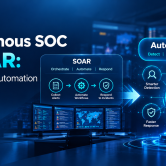
Autonomous SOC vs SOAR: What Is the Difference?
Understanding the difference between SOAR and an Autonomous SOC helps security leaders evaluate where their existing automation strategy may need to evolve.
| Capability | Traditional SOAR Approach | Autonomous SOC Approach |
|---|---|---|
| Primary focus | Orchestration and workflow automation | Coordinated, AI-driven security operations |
| Workflow execution | Executes configured playbooks | Combines automation with AI-supported investigation and decision-making |
| Threat investigation | Automates defined investigative steps | Can help investigate and correlate contextual evidence |
| Alert prioritisation | Applies configured rules and enrichment | Can incorporate contextual analysis and risk-based prioritisation |
| Incident response | Executes predefined response actions | Can recommend or execute authorised actions based on available capabilities and policies |
| Human involvement | Often required for exceptions and complex decisions | Aims to reduce routine intervention while retaining appropriate oversight |
| Adaptability | Depends on configured workflows and platform capabilities | May support more adaptive investigations through AI agents and connected tools |
The distinction is not absolute. Modern SOAR platforms can incorporate AI, and Autonomous SOC platforms can use traditional playbooks.
The important difference is the overall operational approach: an Autonomous SOC aims to coordinate investigation, prioritisation, and response rather than focusing exclusively on automating individual tasks.
Why Traditional SOC Automation Is No Longer Enough
Modern enterprises generate security telemetry across endpoints, identities, networks, cloud workloads, applications, and business systems.
Although security tools provide valuable visibility, analysts must still determine which alerts represent genuine threats, how different events are connected, and what actions should follow.
This creates several operational challenges.
1. Alert Fatigue and Investigation Overload
Security analysts often need to review large volumes of alerts while identifying the relatively small number that require urgent attention.
When alerts lack sufficient context, analysts spend valuable time gathering evidence and validating events.
An Autonomous SOC can help correlate available evidence, enrich investigations, and prioritise alerts so that analysts can focus on higher-risk incidents.
2. Fragmented Security Tools
Enterprises frequently use multiple security technologies for endpoint detection, identity protection, threat intelligence, network monitoring, and security information and event management.
When these tools operate in silos, investigations can require analysts to move between dashboards and manually connect information.
An AI-powered Autonomous SOC can use supported integrations to bring relevant information together and help establish a clearer picture of potential threats.
3. Slow Incident Response
Even after identifying a potential threat, security teams must establish its scope, assess its impact, and determine the appropriate response.
Automating individual tasks can improve response speed, but disconnected workflows may still create delays.
An Autonomous SOC aims to coordinate investigation and response more effectively, subject to configured permissions and operational safeguards.
4. Increasing Security Operations Costs
Hiring skilled security professionals, maintaining multiple platforms, and managing repetitive investigations can increase the operational cost of running a SOC.
Autonomous SOC capabilities can help reduce manual effort and improve resource utilisation.
Actual cost savings depend on implementation costs, integration requirements, workload, and measurable operational outcomes.
How Agentic AI Is Transforming the Autonomous SOC
Agentic AI is an emerging approach in which AI agents can pursue defined objectives, use supported tools, and perform sequences of tasks within established boundaries.
In security operations, specialised AI agents can support different activities across the threat management lifecycle.
Threat Detection: Identify suspicious events that warrant investigation.
Automated Investigation: Gather evidence, correlate related events, and assess potential threats.
Intelligent Prioritisation: Help determine which incidents require attention based on available context and risk.
Coordinated Response: Recommend or execute approved actions through connected security systems.
Continuous Improvement: Use investigation outcomes, feedback, and performance data to improve supported processes.
These capabilities can help reduce the operational gaps between detection and response.
However, AI agents must operate with appropriate access controls, testing, auditability, and escalation procedures. Their decisions should be evaluated against real security requirements rather than assumed to be accurate simply because AI is involved.
For organisations exploring an Agentic SOC, the priority should be demonstrable improvements in investigation quality, operational efficiency, and risk management.
Why IT-OT Security Needs a More Coordinated Approach
For manufacturing companies, critical infrastructure operators, and other industrial organisations, cybersecurity extends beyond traditional IT systems.
Operational Technology (OT) environments include industrial control systems, production equipment, and processes where availability and safety can be critical.
An incident affecting an enterprise endpoint may require a different response from one affecting an industrial control system.
Consequently, IT and OT security teams need to consider both cyber risk and operational impact when investigating threats.
An IT-OT Cyber Fusion Centre can help bring security monitoring, threat intelligence, and operational expertise together.
An Autonomous SOC can support this approach by correlating relevant signals across connected environments, helping prioritise investigations, and coordinating authorised response activities.
OT security requires particular care: response actions must account for industrial processes, system dependencies, safety requirements, and operational constraints.
The goal is to improve visibility and coordination without compromising business continuity or operational safety.
How to Measure the ROI of an Autonomous SOC
Adopting an Autonomous SOC should be a measurable business decision rather than simply a technology upgrade.
Security leaders should evaluate performance against a baseline established before deployment.
Important metrics include:
- Mean Time to Detect (MTTD): How quickly are potential threats identified?
- Mean Time to Respond (MTTR): How quickly are incidents investigated and appropriately addressed?
- Investigation Effort: How much manual work is required to investigate an alert?
- Analyst Productivity: How much time can analysts redirect towards complex threats and strategic activities?
- False-Positive Handling: Can the organisation reduce unnecessary investigations without overlooking genuine threats?
- Operational Cost: What is the total cost of implementation, integration, maintenance, and ongoing operations?
- Response Quality: Are incidents handled consistently within approved security policies?
These measurements help organisations determine whether Autonomous SOC capabilities are improving operational efficiency and security outcomes.
The objective is not to automate every possible activity. It is to reduce unnecessary effort while strengthening the organisation’s ability to manage cyber risk.
How to Choose Between SOAR and an Autonomous SOC
The right approach depends on an organisation’s existing security architecture, operational maturity, and business objectives.
SOAR can be a strong choice for organisations seeking to standardise repetitive processes, integrate security tools, and automate predefined response workflows.
An Autonomous SOC may be worth evaluating when organisations also need to reduce manual investigation effort, improve contextual threat prioritisation, and coordinate multiple stages of security operations.
Before making a decision, security leaders should assess:
- The volume and complexity of security alerts.
- The amount of manual effort required for investigations.
- The integration capabilities of the existing security stack.
- The quality and availability of security telemetry.
- The level of autonomy appropriate for different response actions.
- Governance, auditability, and human approval requirements.
- The expected operational benefits and total cost of ownership.
For many enterprises, the transition does not require abandoning existing automation. Instead, the opportunity is to build on established workflows and integrations while introducing additional AI-driven capabilities where they provide measurable value.
The Future of Security Operations Is Beyond Automation
SOAR has helped organisations connect security tools and automate repetitive workflows. These capabilities remain important to modern cybersecurity.
However, growing threat complexity and increasing volumes of security telemetry are driving demand for approaches that can do more than execute predefined tasks.
An Autonomous SOC aims to combine AI-driven investigation, contextual prioritisation, automation, and coordinated response to help security teams operate more efficiently.
For CISOs, the question is no longer simply whether their organisation has automated security workflows.
It is whether those workflows are helping the business identify meaningful threats, reduce investigation overhead, and respond effectively.
At AiCyberWatch, our focus is on advancing AI-powered security operations and coordinated IT-OT cyber defence to help organisations move towards more intelligent, risk-focused security operations.
Secure with Intelligence. Respond with Autonomy.
Explore the AiCyberWatch Autonomous SOC platform to learn more about the evolution of security operations.