EDR/XDR Solution
 Patch Management as a Service
 OT Security Services
 Zero Trust VPN Access
 PIM/PAM Solution
 Managed SOC Services
 Managed Data Loss Prevention
 MDR Services
 VAPT
VAPT Social Engineering Assessment
 Red Team Assessment
 ESMA – Maturity Assessment
 Imperum


Introduction
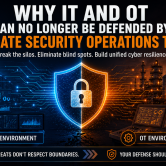
For years, Information Technology (IT) and Operational Technology (OT) operated as separate environments. IT teams focused on protecting data, applications, users, and enterprise networks, while OT teams prioritized the availability, safety, and reliability of industrial operations. That separation is rapidly disappearing. Cloud adoption, Industrial IoT, remote access, smart manufacturing, connected devices, and digital transformation have created stronger connections between enterprise and industrial environments. As these connections increase, attackers have more opportunities to move between IT and OT systems. A cyberattack may begin with a compromised employee account or endpoint and eventually target systems supporting production operations. This changing threat landscape means organizations can no longer depend on isolated IT and OT Security Operations. They need greater visibility, coordinated response, and a unified security strategy. This is where Managed SOC Services and an Autonomous SOC can make a significant difference.
Why Separate IT and OT Security Operations Are No Longer Enough
Traditional security models often operate IT and OT security independently. While specialized teams remain important, complete separation can create visibility and communication gaps.
An IT SOC may detect suspicious authentication or endpoint activity without knowing that the same account is being used to access an industrial environment. Similarly, an OT team may detect unusual activity on an industrial network without having visibility into the enterprise event that initiated it.
Attackers, however, do not follow organizational boundaries.
A compromised endpoint can become a starting point for credential theft, lateral movement, network discovery, and eventual access to connected OT environments.
When security teams operate in silos, they may investigate these activities as separate incidents instead of recognizing one coordinated attack.
IT-OT Convergence Has Created a Larger Attack Surface
Modern industrial environments increasingly depend on connected technologies such as:
- Industrial IoT devices
- Cloud platforms
- Remote monitoring
- Vendor access
- Connected sensors
- Enterprise applications
- Digital manufacturing systems
- Remote maintenance solutions
These technologies improve efficiency and productivity, but they also increase cybersecurity dependencies.
Consider a potential attack path:
Phishing → Compromised Account → Endpoint → Credential Theft → Network Discovery → IT/OT Boundary → Industrial Network
The initial compromise may happen in IT, while the ultimate business impact could occur in OT.
This is why IT/OT Cybersecurity needs to consider the entire attack path rather than treating enterprise and industrial environments as completely independent.
How Managed SOC Services Bridge the IT and OT Security Gap
Many organizations do not have the resources, specialist expertise, or 24/7 staffing required to operate multiple advanced security operations teams.
Managed SOC Services provide organizations with continuous monitoring, threat detection, investigation, and incident response capabilities across their digital environments.
A modern Managed Security Operations Center can help organizations:
- Monitor IT and OT security events continuously
- Correlate activity across different environments
- Detect suspicious behavior and lateral movement
- Prioritize high-risk security alerts
- Investigate potential incidents
- Accelerate incident response
- Reduce Mean Time to Detect (MTTD)
- Reduce Mean Time to Respond (MTTR)
- Support compliance and cybersecurity requirements
Instead of maintaining disconnected security monitoring processes, organizations can establish Unified Security Operations with centralized visibility and coordinated response.
Why Autonomous SOC Is the Future of Security Operations
Security teams face an increasing volume of alerts and increasingly sophisticated attacks. Manual investigation of every alert is difficult to scale and can lead to analyst fatigue.
An Autonomous SOC uses AI, machine learning, behavioral analytics, threat intelligence, and automation to improve security operations.
Key capabilities include:
AI-Powered Threat Detection
AI can analyze large volumes of security telemetry and identify suspicious patterns that may otherwise be difficult to detect.
Intelligent Alert Prioritization
An Autonomous SOC can help distinguish high-risk incidents from low-value alerts by considering asset criticality, user behavior, threat intelligence, and attack context.
Automated Threat Correlation
Individual alerts may appear harmless in isolation. Correlating events across endpoints, identities, networks, cloud environments, and OT systems can reveal a larger attack campaign.
Faster Incident Triage
Automation can enrich alerts, collect evidence, and perform initial investigation steps before an analyst begins a deeper investigation.
Controlled Automated Response
For predefined scenarios, automation can support actions such as endpoint isolation, account suspension, malicious indicator blocking, or incident escalation.
In OT environments, automated actions should be carefully controlled because operational continuity and safety remain critical.
Managed Services + Autonomous SOC
Managed SOC Services and an Autonomous SOC should not be viewed as competing approaches.
They complement each other.
Managed SOC provide:
People + Processes + Technology + Continuous Monitoring
Autonomous SOC adds:
AI + Automation + Correlation + Intelligent Decision Support
Together, they create a scalable security operations model capable of protecting increasingly connected IT and OT environments.
The objective is not simply to process more alerts.
It is to identify meaningful threats faster and help security teams make better decisions.
The Importance of Human Expertise
Autonomous security does not mean eliminating human analysts.
This is especially important for Industrial Cybersecurity, where unusual activity may have legitimate operational explanations.
An unexpected communication could be caused by scheduled maintenance, engineering activity, vendor access, or a system update—or it could indicate malicious behavior.
AI and automation can identify anomalies and provide context, while experienced security professionals evaluate the operational impact and determine the appropriate response.
The strongest model is therefore:
AI for speed.
Automation for scale.
Experts for judgment.
Building Unified Security Operations
Organizations can take several steps toward a more integrated security model:
- Discover IT and OT assets to establish complete visibility.
- Map IT-OT connections and understand remote-access pathways.
- Centralize relevant security telemetry for better correlation.
- Prioritize critical assets based on business and operational risk.
- Adopt Managed SOC Services for continuous monitoring and specialized expertise.
- Automate repetitive security tasks where appropriate.
- Introduce Autonomous SOC capabilities to improve detection and response.
- Continuously improve security operations using threat intelligence and lessons from incidents.
This approach allows IT and OT teams to maintain their specialized responsibilities while working within a coordinated security framework.
Conclusion
The boundary between IT and OT is becoming increasingly difficult to defend as separate security domains.
A manufacturing facility, for example, may depend on enterprise identities, cloud applications, remote vendors, industrial networks, connected machinery, and data analytics. A compromise in one environment can potentially affect another.
Organizations therefore need more than isolated monitoring.
They need Unified Security Operations that combine visibility, specialized expertise, intelligent detection, coordinated response, and automation.
SOC can provide the continuous monitoring and security expertise organizations need, while an Autonomous SOC can enhance threat detection, alert prioritization, investigation, and response.
The goal is not to replace IT or OT security teams.
It is to connect them.
Because when attackers can move across IT and OT, defenders must be able to see across IT and OT too.
The future of cybersecurity is unified, intelligent, and increasingly autonomous.