EDR/XDR Solution
 Patch Management as a Service
 OT Security Services
 Zero Trust VPN Access
 PIM/PAM Solution
 Managed SOC Services
 Managed Data Loss Prevention
 MDR Services
 VAPT
VAPT Social Engineering Assessment
 Red Team Assessment
 ESMA – Maturity Assessment
 Imperum


Introduction: When Seeing and Hearing Are No Longer Enough
For years, enterprise cybersecurity awareness has taught employees to identify suspicious emails, check unfamiliar links, and verify unusual requests. These practices remain important, but artificial intelligence is changing how cybercriminals approach human trust. As these threats become more sophisticated, an autonomous SOC can help security teams identify suspicious activity, investigate potential threats, and accelerate response.
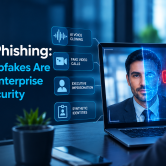
Imagine receiving a video call from your company’s CFO. The person looks familiar, sounds convincing, and asks you to approve an urgent financial transfer. The request appears to come from a trusted authority, and the conversation seems entirely normal.
But what if the person on the screen is not the CFO at all?
AI-generated voices, manipulated videos, and synthetic identities can make impersonation attempts more convincing. Attackers can exploit publicly available recordings, photographs, professional profiles, and organizational information to create believable scenarios designed to influence employees.
This creates a new challenge for enterprise identity security. Organizations can no longer rely solely on recognizing a familiar face, hearing a familiar voice, or receiving a message through an apparently legitimate communication channel.
The priority is shifting from simply identifying suspicious content to verifying identities, permissions, and high-risk actions through reliable processes.
What Are AI Deepfake Attacks in Cybersecurity?
Deepfakes are synthetic or manipulated audio, video, or images generated or altered using artificial intelligence. While this technology has legitimate applications, it can also be misused to impersonate individuals and manipulate business decisions.
In cybersecurity, deepfakes can support social engineering attacks by making fraudulent communications appear authentic.
Common examples include:
- AI voice cloning: Replicating a person’s voice to make fraudulent phone calls or voice messages.
- Deepfake video calls: Using manipulated video or synthetic likenesses to impersonate executives, employees, or business partners.
- Executive impersonation: Pretending to be a senior leader to influence financial approvals, disclose confidential information, or bypass internal controls.
- Synthetic identity misuse: Combining genuine and fabricated personal information to make an identity appear legitimate.
- Multichannel social engineering: Coordinating emails, messages, phone calls, and video interactions to make a fraudulent request seem credible.
These attacks do not necessarily require sophisticated access to corporate infrastructure. In some cases, their purpose is to persuade an employee to take an action that the attacker could not perform independently.
That is what makes deepfake-enabled social engineering particularly concerning: it targets both technology and the people authorized to use it.
Why AI Deepfakes Are Becoming an Enterprise Security Concern
The growing concern is reflected in recent industry research. In a September 2026 survey of 297 senior cybersecurity leaders, Gartner reported that 41% of respondents had experienced at least one social engineering incident involving a deepfake during an employee audio call in the preceding 12 months. Another 36% reported an incident involving a video call.
These figures describe reported incidents among surveyed security leaders, not the percentage of all businesses successfully defrauded. Nevertheless, they demonstrate why security teams should treat synthetic-media impersonation as an operational risk.
Several factors contribute to the problem.
1. Publicly Available Information Can Support Impersonation
Corporate websites, conference recordings, interviews, webinars, and professional social media profiles can reveal how senior executives speak, communicate, and interact.
Attackers may combine this information with leaked or stolen data to create convincing scenarios tailored to specific employees or business processes.
2. Familiar Communication Channels Can Create False Confidence
Employees often trust a known telephone number, a familiar voice, or an expected video meeting. Attackers can exploit this confidence, especially when a request appears urgent or comes from someone with authority.
3. Business Processes Can Be Easier to Manipulate Than Technology
A company may have strong endpoint protection and email security but still depend on an employee manually approving a payment, resetting an account, or sharing sensitive information.
When identity verification is informal, an impersonation attempt can exploit the gap between technical security and operational practice.
4. AI Can Make Social Engineering More Personal
AI tools can help attackers produce fluent messages, adapt scripts to particular audiences, and coordinate multiple forms of communication. This can make traditional warning signs, such as poor grammar or awkward phrasing, less reliable.
The implication is clear: enterprise security needs controls that remain effective even when fraudulent content looks and sounds convincing.
Five Ways Deepfake Attacks Can Threaten Enterprise Identity Security
1. CEO and CFO Impersonation
Senior executives often have the authority to approve payments, authorize exceptions, or request confidential information. An attacker impersonating a CEO or CFO may exploit this authority to pressure employees into bypassing normal procedures.
A fraudulent request might involve an urgent vendor payment, a confidential acquisition, or an emergency transfer.
Security priority: Financial instructions should follow documented approval workflows, regardless of who appears to have requested them.
2. Credential Theft and Account Takeover
A convincing impersonation may be used to persuade employees to disclose passwords, share one-time authentication codes, or approve unexpected login prompts.
Once an attacker gains access to a legitimate account, subsequent activity may appear more trustworthy because it originates from an authenticated identity.
Security priority: Use phishing-resistant multifactor authentication where feasible, protect account recovery processes, and monitor unusual authentication and access activity.
3. Fraudulent Password Resets and Identity Recovery
Account recovery is an important but sometimes overlooked part of enterprise identity security. Attackers may impersonate employees, contractors, or executives to convince a help desk to reset credentials or change authentication methods.
A successful recovery-process manipulation can undermine otherwise strong access controls.
Security priority: Establish identity-verification requirements for password resets, privileged-account recovery, and changes to authentication factors. Avoid relying solely on information that could be publicly available or easily obtained.
4. Vendor and Business Partner Impersonation
Businesses routinely communicate with suppliers, consultants, service providers, and technology partners. An attacker may impersonate a trusted contact to change payment details, request sensitive documents, or obtain access to internal systems.
The risk increases when organizations depend on long-standing relationships and informal approval practices.
Security priority: Independently verify changes to bank details, vendor payment instructions, and access permissions through previously established contact channels.
5. Privileged Access and Internal Trust Abuse
An impersonation attempt can target administrators, IT support personnel, or employees with access to sensitive systems. An attacker may claim that an emergency requires a temporary privilege increase or an exception to normal security procedures.
If access is granted without appropriate validation, the consequences may extend beyond the initial interaction.
Security priority: Apply least-privilege access, time-limited administrative permissions, separation of duties, and additional verification for sensitive actions.
Why Traditional Security Awareness Is Not Enough
Employees should still learn how to identify suspicious communications. However, organizations should not expect every employee to reliably detect a sophisticated deepfake.
Visual glitches, unnatural expressions, unusual speech patterns, or inconsistent audio may sometimes provide clues, but their absence does not establish authenticity. Deepfake detection tools can also produce false positives and false negatives.
A more dependable approach is to make verification a normal part of business operations.
For example, an employee receiving an urgent payment request should not have to decide whether the executive’s voice sounds authentic. The employee should follow an established process that requires independent verification and the appropriate approvals.
This approach reduces reliance on human intuition and creates a consistent security standard across email, telephone calls, video meetings, collaboration platforms, and other communication channels.
The objective is not to teach employees to distrust every interaction. It is to ensure that trust alone cannot authorize a high-risk action.
Seven Practical Measures to Reduce AI Deepfake Security Risks
1. Establish Independent Verification Procedures
Create clear procedures for sensitive requests, including financial transfers, changes to payment details, confidential data sharing, access approvals, and account recovery.
Use a separate, trusted communication channel to verify requests. For example, call a previously registered number rather than a number supplied during the suspicious interaction.
2. Introduce Strong Approval Controls
Require dual authorization or additional review for high-value transactions, changes to critical systems, and other consequential actions.
Approval requirements should remain in place even when a request appears to come from a senior executive.
3. Strengthen Workforce Identity Security
Use phishing-resistant authentication methods where appropriate, implement risk-based access controls, and monitor suspicious sign-ins, new devices, unusual locations, and changes to authentication factors.
Pay particular attention to privileged accounts, remote access, and identity recovery workflows.
4. Apply Least-Privilege Access
Employees and third parties should have only the access required for their responsibilities.
Temporary access should be time-limited, properly approved, and reviewed. Strong access governance limits the damage an attacker can cause if an identity is compromised.
5. Train Employees to Follow Secure Processes
Awareness programs should address voice cloning, video impersonation, fraudulent executive instructions, and manipulated vendor communications.
Teach employees to pause, verify, and report suspicious requests—even when they appear urgent or come from someone senior. Training exercises can test whether employees follow verification procedures rather than merely whether they recognize suspicious media.
6. Monitor Identity and System Activity Together
A suspicious call or employee report may be the first indication of an attack. Security teams should be able to investigate whether the interaction coincides with unusual login activity, password resets, privilege changes, new devices, or unexpected transactions.
Correlating these signals can help identify suspicious activity that might otherwise go unnoticed when individual security tools operate independently.
7. Prepare an Incident Response Plan
Organizations should define how employees report suspected impersonation, how security teams validate the incident, and how affected accounts or transactions are contained.
Response procedures should cover credential resets, session revocation, access reviews, financial escalation, evidence preservation, and communication with relevant stakeholders.
If a fraudulent payment has been initiated, the finance team should promptly contact the relevant bank or payment provider through verified channels. Early reporting may improve the chances of limiting losses.
The Role of Managed SOC Services in Deepfake-Related Threat Detection
Deepfake content is not always directly detectable through conventional security monitoring. A fraudulent voice call, for example, may leave no obvious technical indicator until it leads to suspicious account activity or an unauthorized transaction.
This is where security operations can help.
A well-integrated security operations capability can combine endpoint, identity, network, cloud, and security-event data to investigate potential compromise and identify suspicious activity across the enterprise.
Managed SOC services can support organizations through:
- Continuous monitoring of available security telemetry.
- Investigation of suspicious authentication and access events.
- Correlation of security alerts to identify potentially connected activity.
- Escalation and response coordination based on agreed procedures.
- Threat-informed recommendations to improve security controls and incident readiness.
The exact capabilities depend on the organization’s security architecture, available telemetry, and service scope. A SOC should not be presented as a standalone solution that can reliably identify every synthetic voice or video. Its value lies in helping organizations detect, investigate, and respond to the wider chain of suspicious activity.
For enterprises evaluating their current security operations, AiCyberWatch Managed SOC Services provide a relevant starting point for exploring continuous monitoring and threat response.
What CISOs and Technology Leaders Should Prioritize
Deepfake-related risks are not limited to the cybersecurity team. They can affect finance, human resources, procurement, IT support, executive leadership, and third-party management.
CISOs, CIOs, and CTOs should work with business leaders to identify workflows where an impersonation could result in financial loss, unauthorized access, regulatory exposure, or reputational damage.
A practical starting point is to ask five questions:
- Can a familiar voice or video appearance bypass our identity-verification process?
- Are payment approvals and vendor-detail changes independently verified?
- Could someone manipulate our help desk into resetting a privileged account?
- Can our security team correlate identity events with endpoint, cloud, and network activity?
- Do employees know how to report suspected deepfake impersonation without fear of blame?
The answers can help identify gaps that technology alone may not resolve.
Organizations should also periodically test their procedures through approved simulations and tabletop exercises. These exercises should assess the effectiveness of verification, escalation, and response—not just the ability to spot manipulated media.
Frequently Asked Questions
What is an AI deepfake attack in cybersecurity?
An AI deepfake attack uses synthetic or manipulated audio, video, or images to impersonate a person or mislead an organization. Attackers may use these techniques to support fraud, credential theft, unauthorized access, or social engineering.
How do deepfakes threaten enterprise identity security?
Deepfakes can undermine confidence in voice and video as indicators of identity. They may be used to manipulate employees into approving transactions, disclosing credentials, changing account details, or granting access without following the required verification process.
How can businesses prevent AI voice-cloning scams?
Businesses should establish independent verification procedures for sensitive requests, require appropriate approvals, protect identity recovery workflows, and train employees to report suspicious interactions. Voice recognition alone should not authorize consequential actions.
Can multifactor authentication prevent deepfake attacks?
Multifactor authentication can reduce the risk of account compromise, especially when phishing-resistant methods are used. However, it does not prevent every form of social engineering or fraudulent business instruction. Organizations must combine authentication with access controls, transaction verification, and monitoring.
How can a managed SOC help with deepfake-related threats?
A managed SOC can monitor and investigate suspicious identity, endpoint, network, and cloud activity, depending on the telemetry and service scope available. It can help detect potential account compromise and coordinate response, although it cannot guarantee the detection of every deepfake.
Why is executive impersonation a concern for Indian businesses?
Executive impersonation can target any organization that relies on trusted communications for financial approvals, access decisions, or confidential business processes. Indian businesses should evaluate these risks alongside their existing fraud-prevention, identity-security, privacy, and incident-response obligations.
Conclusion: Verify the Action, Not Just the Identity
AI deepfakes are changing the way organizations must think about trust. A familiar face on a screen or a recognizable voice on a telephone is no longer sufficient evidence that a request is legitimate.
The answer is not to depend entirely on deepfake detection software or ask employees to identify every manipulated recording. It is to build security processes that remain effective even when impersonation is convincing.
Independent verification, strong authentication, least-privilege access, controlled approvals, integrated monitoring, and well-rehearsed incident response can collectively reduce the risk.
As AI-driven social engineering evolves, enterprise identity security must extend beyond recognizing who appears to be communicating. Organizations must verify whether the requested action is authorized, appropriate, and supported by the correct controls.
For businesses strengthening their security posture, AiCyberWatch supports a proactive approach to cybersecurity through security monitoring and response capabilities that help organizations improve visibility, investigate threats, and strengthen cyber resilience.
Because in an era of synthetic identities, security cannot depend on appearances alone.