
 EDR/XDR Solution
 Patch Management as a Service
 OT Security Services
 Zero Trust VPN Access
 PIM/PAM Solution
 Managed SOC Services
 Managed Data Loss Prevention
 MDR Services
 VAPT
VAPT Social Engineering Assessment
 Red Team Assessment
 ESMA – Maturity Assessment
 Imperum


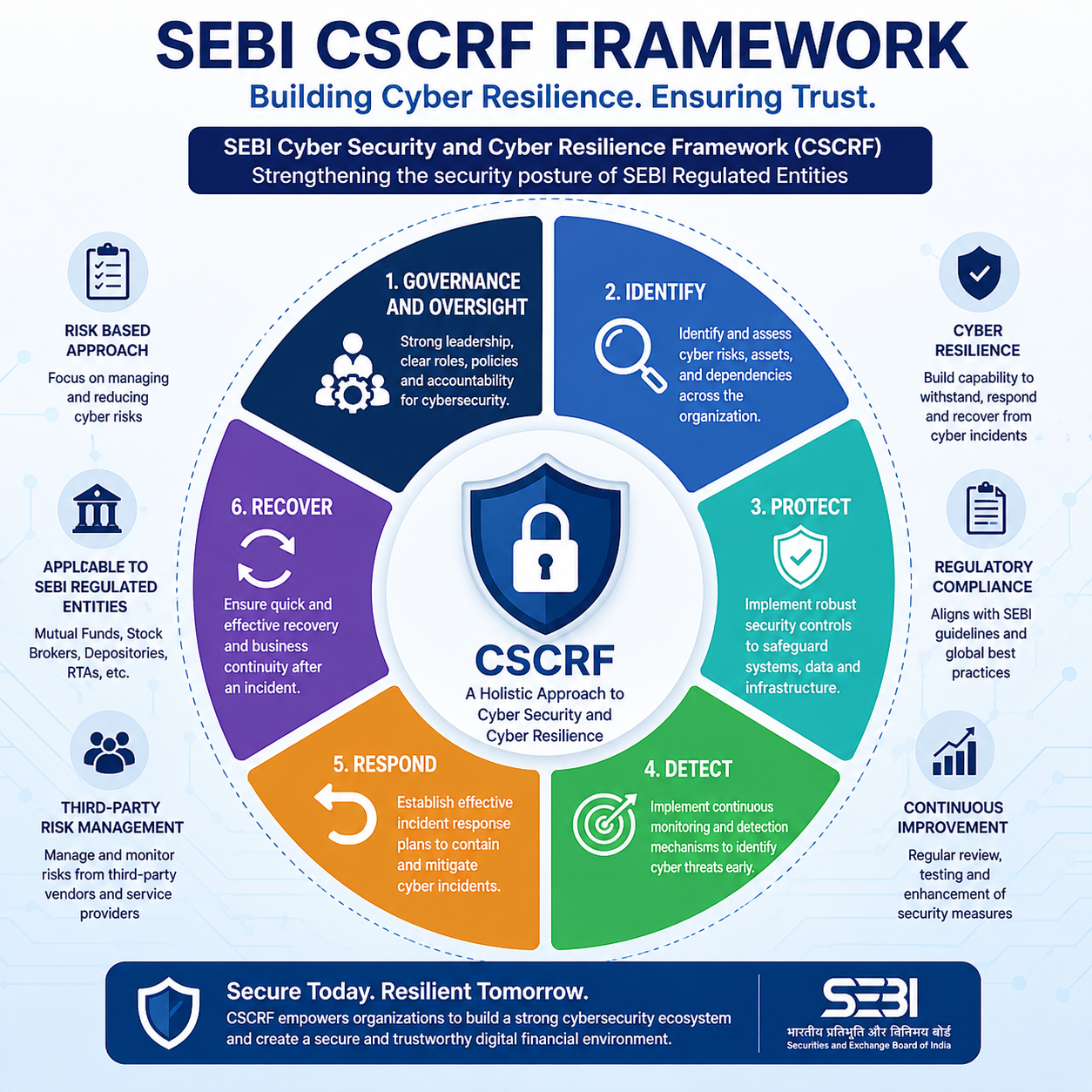
SEBI CSCRF Framework
SEBI CSCRF compliance is essential for financial institutions and market participants to strengthen cybersecurity frameworks and meet the regulatory requirements set by the Securities and Exchange Board of India (SEBI). As cyber threats continue to evolve, organizations must adopt a structured approach to risk management, data protection, and incident response.
This comprehensive guide covers the complete SEBI CSCRF checklist, key compliance requirements, and practical implementation steps to help you stay aligned with SEBI guidelines. It also explains how working with an experienced SEBI CSCRF consultant can simplify the compliance process, identify gaps, and ensure your organization achieves a high level of cyber resilience efficiently and effectively.
Why SEBI CSCRF Compliance is Important
Avoid Regulatory Penalties
Data Protection & Risk Management
Ensure Business Continuity & Resilience
How Our SEBI CSCRF Consultant Services Help
Our SEBI CSCRF consultants simplify compliance with expert guidance, gap assessments, and implementation support. We help you complete the SEBI CSCRF checklist efficiently while ensuring audit readiness and long-term cyber resilience.
- Gap Assessment: We assess your current security posture against SEBI CSCRF compliance requirements, identify gaps, and map them to a clear action plan aligned with the SEBI CSCRF checklist.
- Implementation Support: Our experts help implement required security controls and processes to achieve SEBI CSCRF compliance efficiently with minimal business disruption.
- Documentation & Audit Assistance: We prepare all required policies and documentation, ensuring your organization is audit-ready and fully aligned with SEBI CSCRF standards.
- Continuous Compliance Monitoring: We provide ongoing monitoring and reviews to maintain SEBI CSCRF compliance and strengthen long-term cyber resilience.
1.) Governance, Risk, and Compliance (GRC) Management
- GRC Platform: A centralized tool for managing compliance, audits, and regulatory reporting. Think of it as your command center for staying on top of SEBI requirements.
- Risk Assessment & Management Tool: Helps identify, assess, and mitigate cyber risks proactively, ensuring your organization stays ahead of potential threats.
- Third-Party Risk Management (TPRM) Tool: Keeps a close eye on vendors and partners, ensuring they meet your security standards through continuous monitoring and assessments.
2.) IT Asset Management & Risk Assessment
- IT Asset Management (ITAM) Tool: Tracks hardware, software, and data inventory, giving you a clear picture of your digital landscape.
- Enterprise Risk Management (ERM) Tool: Helps assess cyber risks and plan effective treatment strategies.
- Data Discovery & Classification Tool: Identifies sensitive data like PII and financial information, ensuring it’s encrypted and protected.
3.) Identity & Access Management (IAM)
- Privileged Access Management (PAM) Solution: Controls access for administrators and privileged users, reducing the risk of insider threats.
- Identity & Access Management (IAM) Solution: Ensures only authorized users can access sensitive systems through role-based controls.
- Multi-Factor Authentication (MFA) Solution: Adds an extra layer of security by requiring two-factor authentication.
- Single Sign-On (SSO) Solution: Simplifies user authentication while maintaining security.
4.) Network & Endpoint Security
- Next-Generation Firewall (NGFW): Enforces network security policies to keep malicious traffic at bay.
- Intrusion Detection & Prevention System (IDS/IPS): Monitors your network for suspicious activity and blocks potential threats.
- Endpoint Detection & Response (EDR) Solution: Protects laptops, desktops, and servers from advanced threats.
- Data Loss Prevention (DLP) Solution: Prevents sensitive data from being leaked or stolen.
- Web Security Gateway: Controls internet access and blocks malicious websites.
- USB Device Control Tool: Stops data theft via external storage devices.
5.) Encryption & Data Protection
- Full Disk Encryption (FDE) Solution: Protects data stored on endpoints.
- Email Encryption Solution: Keeps your email communications secure.
- Cloud Access Security Broker (CASB): Monitors and controls access to cloud-based applications.
6.) Security Information & Event Management (SIEM) & Threat Monitoring
- SIEM Solution: Collects and analyzes logs in real-time, helping detect threats and ensure compliance.
- Security Operations Center (SOC) Monitoring: Provides 24/7 threat intelligence and incident response.
- User & Entity Behavior Analytics (UEBA) Tool: Detects insider threats and unusual user activity.
- Threat Intelligence Platform: Keeps you updated on emerging cyber threats.
7.) Application Security & Vulnerability Management
- Web Application Firewall (WAF): Shields web applications from common threats like the OWASP Top 10.
- Vulnerability Management & Patch Management Tool: Identifies and patches security gaps.
- Vulnerability Assessment & Penetration Testing (VAPT) Tools: Tests your systems for weaknesses.
- Source Code Analysis Tool: Analyzes code for security flaws during development.
8.) Incident Response & Forensics
- Incident Response & Forensic Investigation Tool: Helps investigate and recover from cyber incidents.
- Backup & Disaster Recovery (BCP/DR) Solution: Ensures business continuity in the face of disruptions.
9.) Security Awareness & Training
- Security Awareness Training Platform: Educates employees and vendors on cybersecurity best practices.
- Phishing Simulation Tool: Tests and trains employees to recognize and avoid phishing attacks.
10.) Regulatory Reporting & Audit Compliance
- Regulatory Compliance Reporting Tool: Automates SEBI quarterly reports and internal audits.
- Audit & Log Management Tool: Ensures compliance with audit trails and evidence collection.
Explore the complete SEBI CSCRF checklist, compliance requirements, and how a trusted SEBI CSCRF consultant can help you meet regulatory standards efficiently.
SEBI CSCRF Compliance Checklist
Looking for expert guidance on SEBI CSCRF compliance?
Our experienced SEBI CSCRF consultants help you implement the right controls, complete your checklist, and achieve full regulatory compliance. Contact us today to get started.
Frequently Asked Questions
What is SEBI CSCRF compliance?
SEBI CSCRF compliance refers to adhering to the Cyber Security and Cyber Resilience Framework issued by SEBI. It ensures that financial institutions implement strong cybersecurity controls, manage risks effectively, and maintain resilience against cyber threats.
Who needs to comply with SEBI CSCRF?
SEBI CSCRF compliance is mandatory for all SEBI-regulated entities such as stock brokers, mutual funds, depositories, asset management companies (AMCs), and other market intermediaries.
What is included in a SEBI CSCRF checklist?
A SEBI CSCRF checklist includes key areas like risk assessment, governance policies, access control, data protection, incident response planning, continuous monitoring, and regulatory reporting requirements.
How can a SEBI CSCRF consultant help?
A SEBI CSCRF consultant helps organizations assess gaps, implement required security controls, prepare documentation, and ensure audit readiness for complete SEBI CSCRF compliance.
What are the penalties for non-compliance with SEBI CSCRF?
Non-compliance with SEBI CSCRF can lead to strict penalties, which may go up to ₹250 crore depending on the severity of the violation, along with legal and reputational risks.